
You might know the DARPA Legged Squad Support System (LS3) as the Boston Dynamics Big Dog. The concept was to make a robotic pack mule that can carry payload for infantry on foot without the limitations of wheeled vehicles. The system was already pretty impressive back in 2010:
Category Archives: Science & Engineering
Flipping Cats – Smarter Everyday
You all knew it was going to come to this. In my bid for infinite internet fame and glory I will now be posting a cat video. What we’ll be talking about today is one of the universe’s great mysteries. How does a cat always land on its feet?
Before you start the video, here’s a little background information on Moment of Inertia. Don’t worry, it’s not nearly as complicated as it sounds and you already intuitively understand it from your time on the playground as a kid/kid at heart. Lets start with the conservation of energy. Lets say you have two boys sitting on skateboards that you are going to push down the sidewalk. One of them is skinny and one is fat. If we give both kids a push with the same amount of force, which one will go faster? Well that’s easy; the skinny kid goes faster because he has less mass. You could even go as far as to say that the fat kid’s extra mass makes him resistant to acceleration.
OK, now lets take that same concept and apply it to the merry-go-round. With the kids on skateboard we were looking at their linear speed rolling down the sidewalk. On the merry-go-round we’ll be looking at how fast it’s spinning. The two cases we’re going to compare are when everybody sits in the center of the merry-go-round vs. the outer edge. Even though the merry-go-round passengers weigh the same in both cases, the merry-go-round is easier to turn when everybody is sitting in the center because it has a smaller moment of inertia. The energy put into spinning the merry-go-round results in a higher RPM just like skinny kid went faster on the skateboard when we pushed him. When all the passengers move to the outside, the moment of inertia increases and the merry-go-round becomes more resistant to gaining RPM’s just like the fat kid on the skateboard was resistant to acceleration. So the next time some weirdo asks you about the moment of inertia of something, all you have to do is think about how fat the merry-go-round is.
Now watch the cat video:
You can think of the cat as having two merry-go-rounds attached to its spine, one from its front legs and one from its rear legs. Spreading one pair of legs increases their moment of inertia which gives the cat something to “push off of” to rotate the other pair of legs even though it’s free falling. This gives the cat the ability to rotate each pair of legs so they’re always pointed at the ground. Unfortunately this means there’s no mythical spinning force that causes cats to always land on their feet. That doesn’t make the concept of the buttered-toast-taped-to-a-cat perpetual motion machine any less hilarious, though.
Sources: Smarter Every Day and Flying Horse on YouTube
Formula Ford EcoBoost
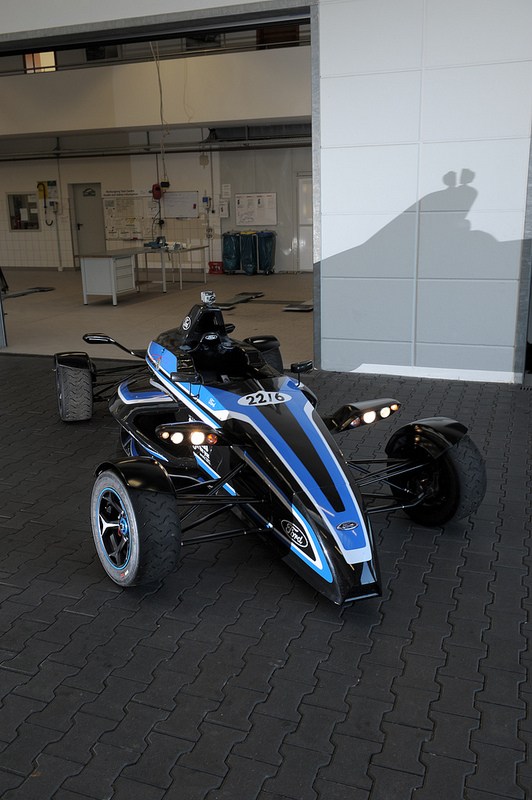 Ford Europe is celebrating the 3 cylinder, 1.0 liter version of their EcoBoost engine winning Engine of the Year by putting it into a Formula Ford race car. The tuned version of the EcoBoost going into the car makes 205 horsepower while achieving 57 mpg at a constant 75mph. Ford added new livery to the car and made it street legal with a full set of lights. After they were done, the car turned in a 7:22 at the Nurburgring Nordschleife which ties the Dodge Viper ACR and is faster than the Nissan GT-R.
Source: Ford of Europe on YouTube via TechnologicVehicles.com
A New Page in the Evolution of the GT-R
 I’m not going to do my usual number of posts today because I’d like everybody to focus their attention to this video released by the Nissan Newsroom. It’s a 20 minute mini-documentary about the GT-R development team’s experience at this year’s 24 hours of Nurburgring. I know it’s a lot to ask of your internet browsing time, but please trust my judgement on this one if you have enjoyed the content of this blog. The documentary has a backdrop of racing, but I wouldn’t say it was about racing. Instead, it’s a truly moving record of a group of engineers and mechanics who have the utmost passion for the development of the automotive pride of Japan. The GT-R development team entered the 24 hours of Nurburgring as a separate entity from Nissan’s factory racing branch, NISMO. Their goals were not to produce a special race car for the event. Their entry was a 2013 GT-R Track Package that was mostly production based. The team used the race to expose the GT-R’s weaknesses at higher speeds and more importantly to grow the skills of the engineers and mechanics responsible for the car’s development under harsh conditions. They knew that they would have to become better at building GT-R’s if they were going to meet the hopes and dreams of their future customers. The GT-R program is unique in that it has continued in full scale development even after the car was released. That’s why the new 2013 model is almost incomparably good when put next to the first 2007 GT-R. In the end, the failure of a 12 cent c-clip prevented the team from having perfect race results, but they were more than successful in growing the teams ability to shape the future of the GT-R. Head over to our Facebook page to discuss this video with other Flux Auto fans.
Source: Nissan Newsroom on YouTube
DARPA Captive Air Amphibious Transport (CAAT)
Meet the 1/5 scale tester of the DARPA Captive Air Amphibious Transport (CAAT). It’s designed to be a literally go anywhere vehicle that can provide relief supplies to disaster areas, kind of like the Gama Goat was intended to be. The difference here is that the CAAT seems to work way better being fast and unstoppable on land, water and everything in between. The BANGshift editor who posted this video thinks that “Captive Air” refers to the air trapped in the paddles of the treads. Seems to make sense to me. It’s one of those straight forward designs that makes you wonder why nobody thought of it before. It definitely adds another dimension to the Monster Tank story.
Source: DARPA tv on YouTube via BANGshift.com