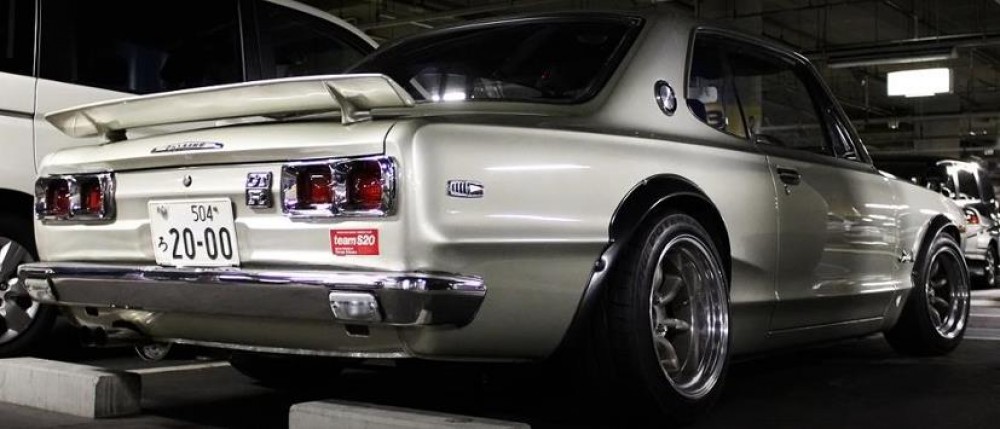
Japanese drifting star Daigo Saito made huge news this year when he announced that he would be competing in the US Formula D series for 2012. Saito originally drove in the D1 Grand Prix in Japan where he built a reputation for being a high speed specialist eventually becoming champion in 2008. Daigo rescued a tsunami damaged Toyota Soarer (Lexus SC430) and put a 1200 hp 2JZ under the hood to compete here in the US. He was second in points behind Vaughn Gittin Jr. heading into the seventh and last round for this year’s series at Irwindale Speedway. Check out the coverage from Achilles Tires to see how Daigo Saito ended up winning the championship:
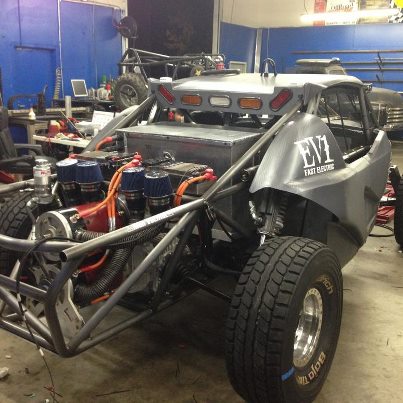
The awesome team of maniacs over at EV West continues to make innovations in practical electric vehicle performance. They like to use Netgain brushed DC motors with Evnetics controllers to produce motorsports-capable power for a fraction of the cost of equivalent high voltage AC systems. The Netgain motors are based on existing fork lift technology and have are proven performers in the EV community. The SRI EV1 uses two motors like their 700 horsepower E36 M3 Pikes Peak Car. The motors are stacked vertically at the rear of the buggy to work with the VW style transaxle. EV West chose to go with two 1000 amp Evnetics Soliton 1 controllers instead of one 3000 amp Soliton Shiva like in the M3. My guess is that using the two smaller controllers allows better torque modulation accelerating out of turns. They had to turn down the power from the Shiva in the M3 at Pikes Peak because it was breaking the tires loose too easily. The dual Soliton 1’s probably makes it easier to put down power on a two wheel drive vehicle on a loose surface. That doesn’t mean the SRI EV1 is a slouch. It makes 500 hp and 700 ft-lbs of torque with a range of 100 miles. Check out the testing footage:
This is an interesting video for a couple of reasons. The first part has to do with the NSX-GT FR. The story behind the car begins in 2007 when the sanctioning body of the Japanese Grand Touring Car Championship (JGTC) announced a regulation change that would require all of the GT500 class cars to be front engine with rear wheel drive (FR) layout. At the time, Honda was racing with the mid-engine NSX. The NSX was Honda’s halo performance car with the rest of their sports car lineup being front wheel drive. The NSX-GT FR was built by Honda R&D to see how feasible it would be to adapt the NSX chassis to a FR layout. That’s why the nose of the car in the video will look abnormally stretched and it’s cornering attitude will seem a bit odd compared to the rest of the NSX’s you’ve seen. Honda ultimately decided to develop a clean sheet design for an FR chassis, the HSV-010, specifically for competing in JGTC. The NSX-GT FR was thought to have been scrapped, but it turns out it was just put into storage at the Honda R&D facility after it was used for testing in 2007.
The second reason this video is interesting is the re-emergence of the NSX-GT FR. Honda surprised the Japanese press when they randomly showed up at the Twin Rings of Motegi circuit with the car in 2010. It turns out they were testing a Kinetic Energy Recovery System (KERS) by Zytek, the same company that makes the KERS system currently used in Formula 1 racing. Honda R&D was seeing if KERS would be feasible for widespread adoption in the JGTC series. The NSX-GT FR was a natural candidate since it was already available and it wouldn’t give Honda any extra testing time with the HSV that was still being campaigned. If you listen carefully, you can hear the KERS working under braking and the car rolling down pit lane in pure electric mode.
Check out this vintage documentary of Cosworth building their first turbo V6 engine for the Beatrice Haas Lola F1 team in 1986. They came up with some interesting engineering solutions for dealing with the forces that the internal components see at high rpm with forced induction. There’s definitely some assembly steps that you won’t see on any road going mass produced engine.
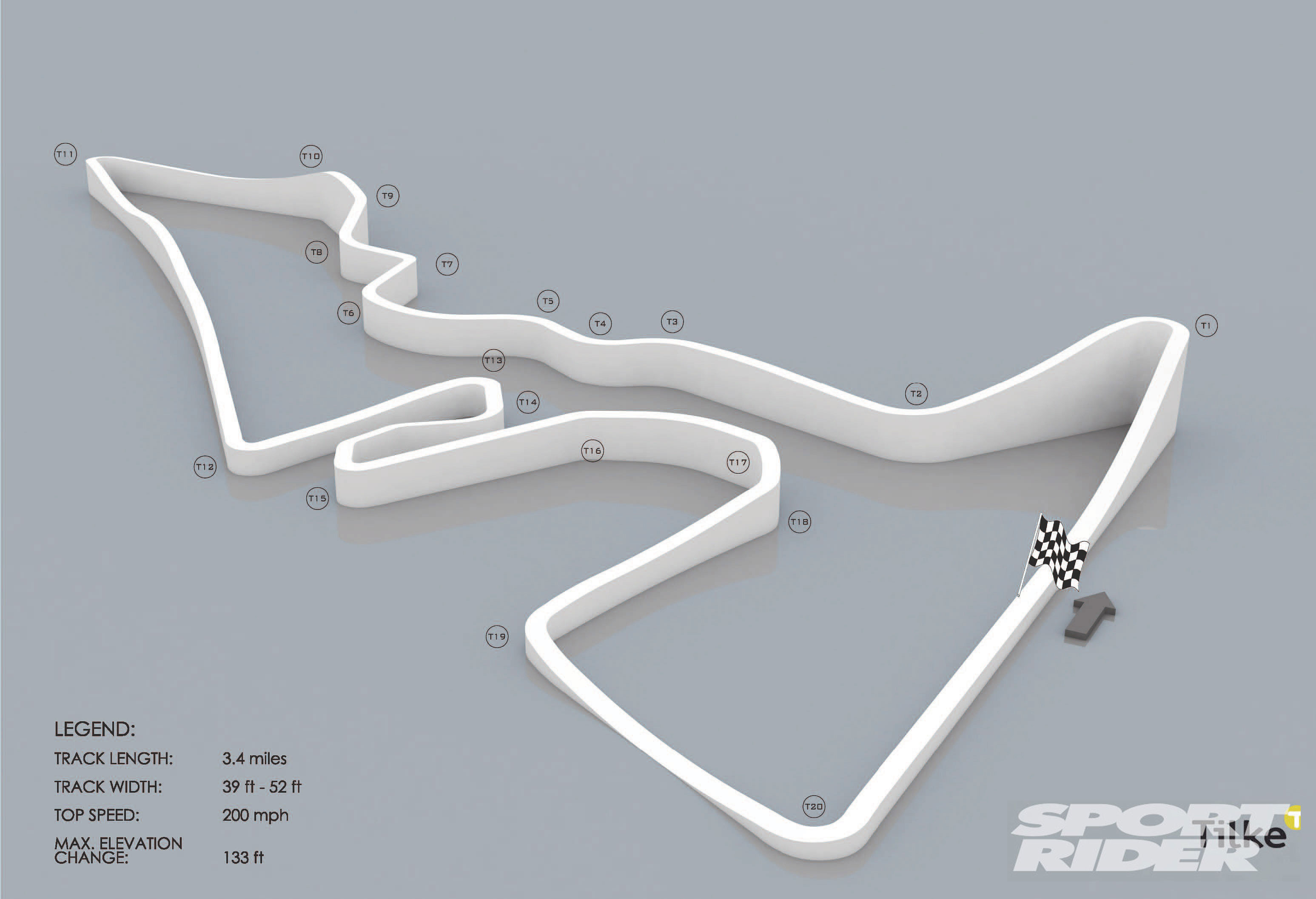
The Circuit of the Americas in Austin, Texas officially opened last week with less than a month to spare before the Formula 1 American GP is scheduled to take place there. Our first look at the track layout came courtesy of the Codemasters F1 2012 video game a few months ago. The actual track looks even more challenging and technical in person, especially the crazy uphill hairpin Turn 1 that Mario Andretti is calling the track’s “marquee corner.” It’s definitely going to take a talented driver to master COTA and I think there’s going to be a fair amount of passing under braking and in turns. The first official lap of the track was driven by Mario Andretti in the Lotus 79 race car that he drove to become the F1 World Champion in 1978. The second lap was done by Lotus test driver Jerome D’Ambrosio in a current Lotus F1 car. D’Ambrosio’s lap gives us a good idea of what the F1 race in a couple of weekends is going to look like. Here is D’Ambrosio’s lap with his commentary.
This second video is the full on-board footage of Mario Andetti’s lap and D’Ambrosio’s lap in HD. Unfortunately embedding was disabled so you’ll have to click over to YouTube to watch it: