Here’s another representative of the proud Australian burnout culture. The car’s name is Kranky and it’s a supercharged V8 Holden HQ. The first run is a pretty standard tire slaying burnout. The second run is where things get crazy. I’m guessing they have some sort of fuel spray in the exhaust because there is a giant firestorm as soon as the burnout starts. The entire backdrop starts burning while the guys continue on their run.
The Raleigh/Cary Cars and Coffee group meets every first Saturday of the month at Waverly Place in Cary starting at about 8am. Any and everybody is welcome to attend no matter what kind of cars or motorcycles you are into.
Chevrolet is commemorating the end of the C6 with this special edition 427 Corvette. Carlos Lago of Motor Trend takes it for a spin while reminiscing about the C6 Corvette’s quirks as well as the attributes that made it an unrivaled performance per dollar bargain.
Porsche has really done a great job with the new 991 generation 911 and the all new Boxster. As Chris Harris pointed out in his review of the new Boxster, the performance gap between Porsche’s entry level car and their bread and butter 911 has become minutely small. The Boxster has sold well enough through the previous two generations that Porsche no longer blatantly neuters the car to protect 911 sales. That begs the question of exactly how large is the performance gap between the Boxster and the 911 now if it even still exists? Car and Driver’s European correspondent, Jethro Bovingdon, pits the two cars against each other. To make the comparison interesting, they test the fastest (S model with active suspension and torque vectoring differential) but still significantly cheaper Boxster vs. a bare bones 911 Carrera at the drag strip and at the very technical Landlow circuit. I won’t spoil the results, but the take away here is that Porsche is on the money with both cars having gained a massive performance boost with their redesigns.
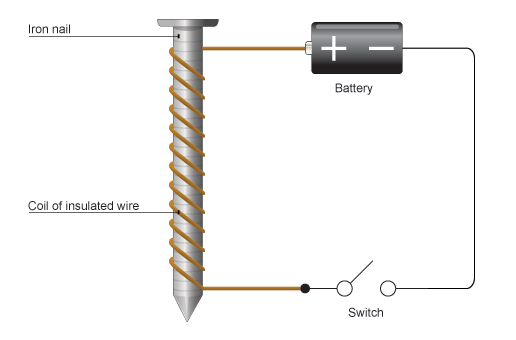
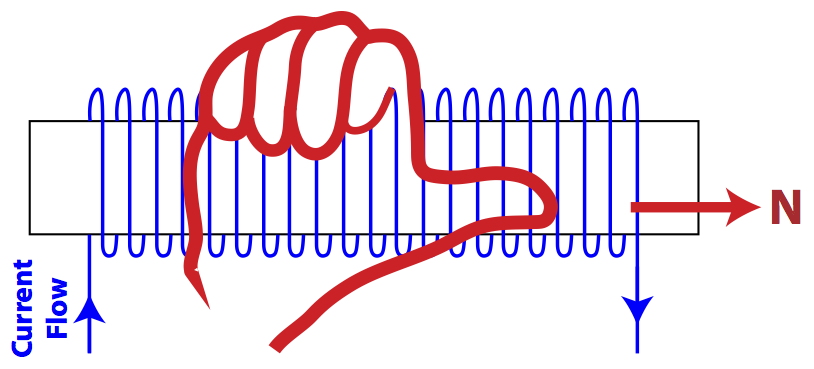
Hopefully you have built one of these simple electromagnets somewhere along your journey to become an educated human being. If you understand the basic principle of how an electromagnet works, then you can understand how wireless inductive charging works. In an electromagnet, the flow of electrons (current) causes a magnetic field. The magnetic field forms at a right angle to the direction of the current (the right hand rule). That means as the current flows in a circle around the nail (the fingers of your right hand wrap around the nail), the magnetic field forms along the nail (your right thumb points in the direction of the magnetic field) putting the poles on either end of the nail. If you’ve built one of these basic nail magnets, then you intuitively understand this already.
Here’s the really cool part. This relationship between current and magnetism works in reverse. A fluctuating magnetic field will also create a current in an otherwise dormant wire. Sustain the situation and you will eventually produce enough current to charge a battery. This is usually done with two coils of wire similar to the ones you wrapped around that nail to make an electromagnet. One of the coils is hooked to a power source and the other coil is hooked to whatever it is you’re trying to charge. The coil connected to the power source becomes an electromagnet that is switched on and off at very high frequency. This transforms the electrical energy into a usable form of magnetic energy. When the second coil is in range of the fluctuating magnetic field of the first coil, it transforms the magnetic energy back into electrical energy like an inverse electromagnet. Rapidly turning the electromagnet on and off allows you to broadcast energy as a magnetic field that can travel through the air without a physical wire connection. Check out this video from Veritasium to see how these principles were first discovered and a rad magically illuminated floating grill that would be perfect in a science nerd man cave.