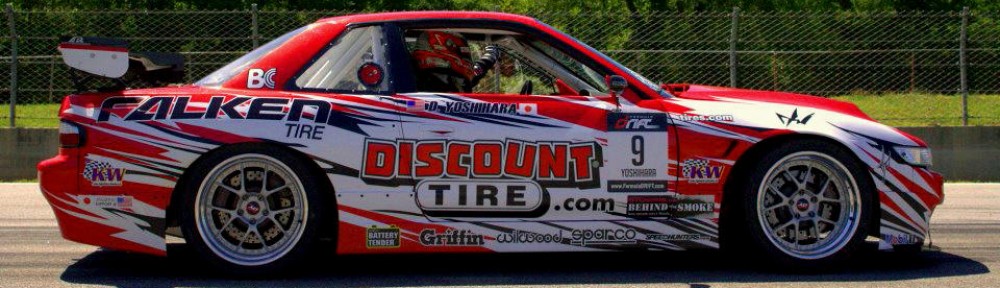
GT Channel brings us this exclusive footage from this year’s SEMA show. The CEO of Polyphony Digital and creator of the Gran Turismo series of racing games for the Sony Playstation, Kazunori Yamauchi, gets drifting lessons from the 2011 Formula D Champion, Diajiro Yoshihara in his LSx powered S13 Nissan 240SX. Yamauchi-san visits the SEMA show to pick give out awards to his favorite cars which are then featured in the Gran Turismo games. What makes this interesting is that Yamauchi-san clearly has an excellent understanding behind the physics and mechanics of car control, but has never tried drifting before. Check out how he does:
This week’s episode of Jay Leno’s garage introduces us to the Mazda Cosmo 110S. The Cosmo represents a classic Japanese halo car from the 60’s. It was also Mazda’s first attempt at a rotary engine powered sports car. We never got any Cosmos here in the US, but this particular car was imported by a U2 spy plane pilot when he returned from his service in Japan. When Jay bought it, the body was in good shape but the engine had seized. Leno’s mechanic replaced the engine with a 1.2 liter 12A rotary engine from the first generation RX-7 with a couple of power upgrades including a Weber sidedraft carburetor and manifold. The car now has over 200 horsepower and a 9,000 rpm redline.
Bathurst is my favorite track. You literally race up and down a mountain each lap. It’s one of the marquee tracks of the Australian V8 Supercar series. Ride along with Rick Kelly as he guides around the track and then lets the car do the talking for one lap. I really wish Gran Turismo would put Bathurst in the next game.
In the last Veritasium video, we explained that wireless inductive charging worked almost like an electromagnet in reverse. In your standard elementary school electromagnet, you run a current in a coil of wire wrapped around a nail to induce a magnetic field (check out the discussion of the first video if you don’t know what I’m talking about). Induction works the opposite way where a quickly moving or changing magnetic field is able to produce current. You can use this effect to essentially beam power over air gaps as demonstrated in the first video.
Now lets take this concept one step further. We’ve already established that there is a relationship between electric current and magnetism that can be manipulated to work in both directions. Can we use the principles of induction to produce a magnetic force in a non-ferrous conductor like copper or aluminum? What do you think? Here’s a hint: think about the “levitating barbecue” from the first video. Intuition will tell you that copper and aluminum are not magnetic. That’s why the simple demonstration in these new videos will surprise you:
And here’s a further explanation from a professor at Nottingham University:
So it is possible to produce a magnetic attraction in copper and aluminum. The key to the process is that the conductor has to be a circular shape and the magnet has to pass through the center of it at a decent speed. Here’s an easy way to think about it: picture the copper tube as the coil of wire around the nail in that same elementary school electromagnet that you built. In the discussion for the first Veritasium video, we talked about how the current flowing in a circle through the coil causes a magnetic field in the nail because of the right-hand rule. The current is supplied to the coil of wire by the battery. With the magnet in the pipe demonstration, we obviously don’t have a battery. So how does the copper pipe produce an electromagnetic force? The answer is that we are adding energy to the system through gravity. There are two separate processes happening:
1. The magnet falls through the pipe. We input the energy to the system by lifting the magnet up to the top of the pipe. As gravity pulls it to the bottom of the pipe, it’s picking up speed. As we’ve already discussed, the moving magnetic field produces a current in the pipe.
2. The current in the pipe flows in a circle like the coil of wire on the nail and battery electromagnet. This produces an electromagnetic field in the opposite polarity of the magnet falling through the pipe. That’s why it resists the magnet’s motion and it takes longer for the magnet to fall than the chunk of aluminum.
You could say that dropping the magnet through the copper pipe is making an electromagnet powered by induction. It’s kind of neat to see both processes demonstrated in one simple experiment. If you can wrap your mind around this then you pretty much understand why electric motors are also generators based on the magnetic phasing or rotation direction.
The Monster Energy off-road team recaps how they did for this year’s Bluewater Desert round of the Best in the Desert series. This event is unique in that it’s a blend between desert racing and short course racing which attracts teams from both disciplines. The guys have do three 25 mile laps on each day. Check out the video to hear from the drivers on how that changes their approach to the race.