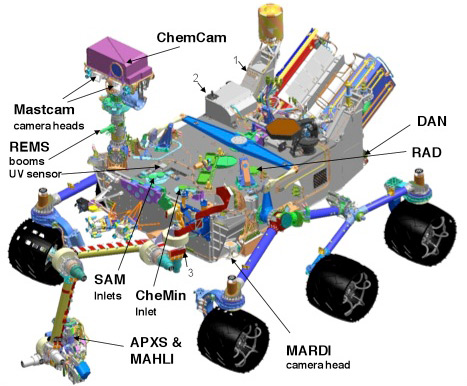
Andrew Bodov of 360 Cities took the 360 degree color image of the Gale Crater sent back by NASA’s Curiosity Rover from Mars and turned it into an interactive panoramic similar to Google Maps Street View. You can click and drag to look around and there’s even a pretty good view of the rover itself:
I posted this picture of the GreenGT H2 on the Flux Auto Facebook page and got a question about the details of the car and how hydrogen fuel cells work. This post will address all of those things. Lets start with the car. The H2 is made by a French vehicle R&D company called GreenGT. It will be racing in the 24 hours of Le Mans next year in the Garage 56 experimental car exhibition spot that was occupied by the Nissan DeltaWing this year. The chassis of the car is made by Welter Racing and their are two electric motors that produce 540 horsepower to drive the wheels to a top speed of 186 mph. The interesting part H2 comes from the energy storage system. The orange tanks on the side of the car hold enough hydrogen gas to power the car for 40 minutes at a time. The H2 has a high temperature Proton Exchange Membrane Fuel Cell (PEMFC) that produces 340 kw. To be more specific, the car carries 18 combined cells that produce 20 kw each with one functioning as a backup. The science behind fuel cells is that a semi-permeable membrane separates hydrogen gas and oxygen. This membrane only allows protons to pass through it. What happens is the electrons and the protons from the hydrogen gas split up. The protons pass through the membrane and bond with the oxygen to form water. The electrons travel down the membrane to be used as electrical energy. Here’s a video illustrating the chemistry:
The theory behind fuel cells is sound (i.e. they actually work), but practical implementation is still lacking. Currently they are only a little more efficient than combustion engines even though they come in a much bulkier package. Harvesting, transporting and storing hydrogen also presents it’s own set of problems. The general public tends to associate hydrogen with the Hindenburg and seem to think it’s an explosion hazard(the same was said about gasoline when we switched from steam powered cars). In reality, a hydrogen leak is actually safer than a gasoline leak. Hydrogen gas dissipates extremely quickly since the molecules are so light. You will lose the gas before it has a chance to detonate which is a lot safer than liquid gasoline pooling up under a leak. The quick dissipation of hydrogen gas is also what makes it difficult to store. Since it’s the smallest atom, it tends to find its way through other materials. Fuel Cells are a clean way of producing energy but face similar R&D barriers as the rest of the green industry.
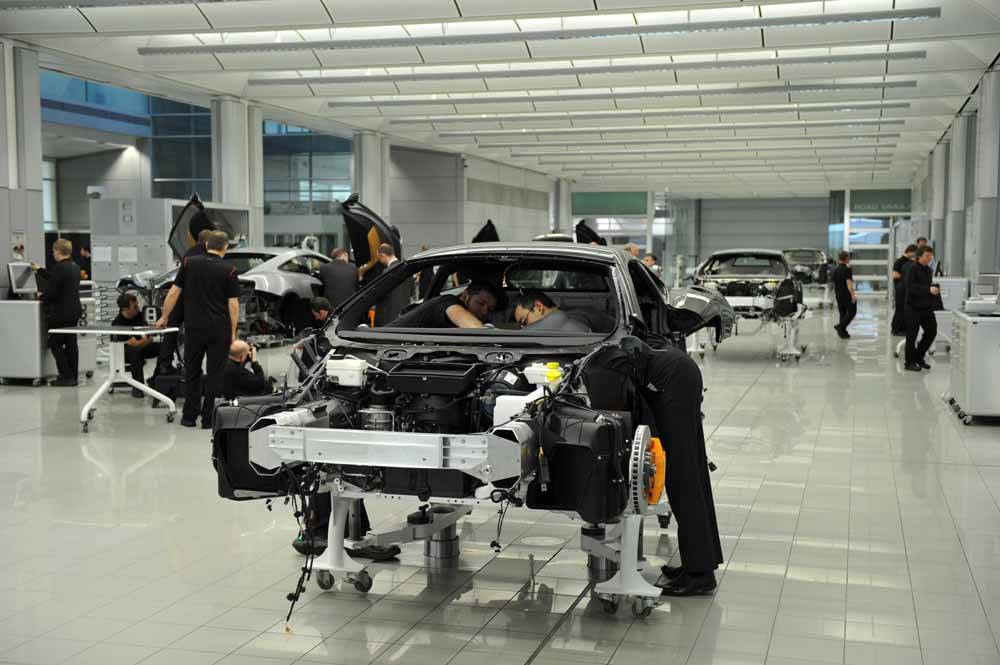
This is an episode of a show on BBC called “How to Build a _____.” It’s similar to shows like “How It’s Made” or “Ultimate Factories,” but seems to have a significantly larger production value. This episode of the show focuses on the current pride of the British Automotive Industry: the McLaren MP4-12C. You’ll get an inside look at the current McLaren factory as well as the new production facility that was opened to quadruple production on the MP4-12C. The new facility was opened to meet the demand for the new car whose waiting list is already up to two and a half years. We also get a view of the cars being assembled including the bonding of the aluminum crash structures to the carbon tub, installing the engine and painting the body panels. The show gets access to a couple of top secret development areas where clay models of potential car designs are made and the echoless room where the exhaust note was designed. McLaren is known for their fanatical attention to detail and you can see that in every square inch of their sterile production facilities and all of their processes. I’m usually a little leery of hour long videos, but I really enjoyed this one.
Lets say you wanted to teach kids about why heat cycling new tires is important. It’s up to you to impart important fundamental gear head knowledge to these blossoming young minds. So how do you do it? Maybe we should sit the kids down in the classroom and lecture them about the polymer chain structure in rubber that heats up when distorted. Chances are they’ll end up texting their friends about how much they hate you. You might even make Twitter for being the heinous old person who was forcibly torturing them with the atrocities of totally lame science stuff.
There’s a better way to learn about how rubber works with little risk of being labeled “cray cray”, at least not the bad kind. It involves shooting slingshots, preferably with a huge German dude that runs the world’s largest slingshot forum and builds crazy new slingshots every week for his YouTube channel. Destin of Smarter Everyday did a collaboration video with Jörg Sprave of the Slingshot Channel to explore how to get the most out of a rubber band.
Lets talk about the two questions at the end of the video. Continue reading →
I promise to make a post about the RX-8 I bought for the EV conversion soon. Until then the quick and dirty details are that I towed it home and it runs perfectly, so I’ve been driving it around and enjoying my first rotary powered car. It drives absolutely amazing which has piqued my interest in rotaries in general. This video has been the best explanation of how one works that I’ve found on YouTube:
When you’re talking rotaries, it doesn’t get much better than the Mazda 787B. It has a 4 rotor engine with variable length intakes mounted midship. The 787B was the first and still the only Japanese car to win the 24 hours of Le Mans. This video was taken at last year’s 24 hours of Le Mans to commemorate the 20th anniversary of the victory. Mazda got one of the original drivers to take the 787B around a full lap of the Circuit de la Sarthe.