How Anodizing Works

Chances are if you’ve bought a nice aftermarket part for your car that was made from aluminum, it was anodized. Anodizing is used to create a tough finish that doesn’t add a layer of thickness to an otherwise precision machined aluminum pieces like paint or powder coat. This is accomplished by purposely oxidizing, aka rusting, the aluminum. Unlike steel, when the surface of aluminum oxidizes it becomes very hard and it seals the rest of the aluminum from oxygen. Anodizing runs electricity through the aluminum to grow an extra thick layer of aluminum oxide while sealing in dyes to give your aluminum parts a good lucking durable finish. Check out this video by The Engineer Guy explaining the titanium and aluminum anodizing process.


Source: The Engineer Guy

Build The Enterprise

A website launched last month called “Build the Enterprise.” It isn’t some cheesy fan fiction site or else I wouldn’t be posting about it here. The curator of the site claims that he’s an experienced electrical engineer from a Fortune 500 company and he legitimately thinks that if mankind pooled its resources, we could actually build a starship in the next 20 years. The plans for his Enterprise use the same basic shape as the ship from Gene Rodenberry’s science fiction show because it’s actually quite functional once you move a couple of things around. This “Gen 1 Enterprise” would house 1000 people, be run on a nuclear reactor and have ion propulsion. It’s really quite well thought out and planned to the point of having schedules and projected budgets. Check it out for yourself.

Sources: Build the Enterprise via IO9

Mars Rover Curiosity

The NASA Jet Propulsion Laboratory released this animation of the next Mars Rover, the Curiosity. Once launched from Earth, it will take 8.5 months to reach Mars. Once there, it will explore the surface using a laser and robot arm that collects samples for the lab tools inside it’s body. The Curiosity will be powered by a radioisotope system that generates electricity from the heat of the decay of plutonium. This will give the rover at least two years of exploration on the surface of Mars.


Source: NASA’s Jet Propulsion Laboratory News

Back in Black With Adam Savage and ArcAttack!

If this isn’t one of the simultaneously cool and nerdy videos that you’ve ever seen, then you’re just too hard to impress. The motivation behind the Science & Engineering posts on this blog are to show people that learning isn’t always about dry math and boring analysis. Figuring out how things work and then turning around and using it to your advantage can be fun and improve the things that touch your life. Case in point: this video. The band playing the music is called ArcAttack. They built two custom Tesla coils that shoot half million volt arcs up to 12 feet. There’s also a robot drummer and LED light show to go along with the live members of the band. This particular performance was shot at this year’s Bay Area Maker’s Faire where Adam Savage gave a speech before agreeing to get inside the Faraday cage while ArcAttack! performed. Without the pursuit of science and inventing, we would be devoid of awesome things like AC/DC literally being played with lightning.


Source: Brian Boyko on YouTube and ArcAttack!

Non-Newtonian Fluid Pothole Patch

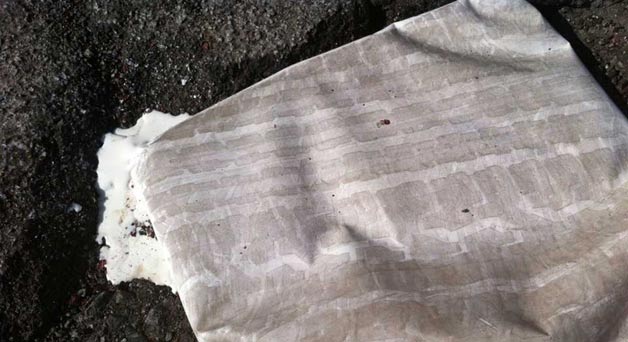
Prototype Pothole Patch

Undergraduate engineering students at Case Western Reserve University just won a contest sponsored by French materials company, Saint Gobain, with their idea for a pothole patch. The students wanted to address an annoying problem that was found worldwide and settled on coming up with a solution for potholes. Their design for a temporary pothole patches uses pouches filled with a non-Newtonian fluid. In order to understand why non-Newtonian fluids are cool, you first have to understand viscosity. A fluid’s viscosity tells how well it’s able to resist a change of shape when force is applied to it. It’s basically how thick a fluid is. Thick fluids have high viscosity and require more force to change their shape than a thin, low viscosity fluid. This quick video is a side by side comparison of two fluids with very different viscosities:


Continue reading