
How It’s Made: Brembo Carbon Ceramic Brake Rotors

Traditional brake rotors are made from steel because of it’s hardness and wear resistance. Steel rotors are cheap and easy to cast, but pretty heavy and heat up very quickly. New brake rotor technology uses ceramics instead of steel. Ceramics are harder than steel and they also transfer very little heat. The problem with ceramics is that their exceptional hardness also causes them to be very brittle. In order to use ceramics in a harsh application like brake rotors, they have to be embedded in a composite. In these Brembo rotors, the silicon carbide ceramic is embedded in a carbon fiber resin. The composite structure gives the rotors the best of both worlds. The ceramic allows the rotor to wear longer than steel and the carbon fiber makes it significantly lighter. The downside is they’re a lot more complicated to produce, which is what makes this video interesting.


Brembo releases a quick facts video about the braking requirements seen by Formula 1 cars at each track. The cars at this past weekend’s Spanish Grand Prix were seeing 5.58 g’s of deceleration which came from the brake system producing 2289 kilowatts of braking power. That means you would need an engine with over 3000 horsepower to produce that kind of deceleration.


Source: How It’s Made via YouTube user tvsurfer319, Brembo
Water Drop Waves in Space

This is another video from astronaut and chemist, Dr. Don Pettit, on the International Space Station. He’s the same guy who made the Bubbles and Anti-Bubbles in Space video. This time he’s experimenting with water droplets on speakers. He’s playing tones through the speakers and sweeping through different frequencies to observe their effects on the droplets. The interesting thing about this is that there is no gravity to dissipate the waves from the surface of the water. The water droplets are able to hold some very interesting shapes depending on their size and the tone frequency.


To break this down even further, you have to take a look at wave behavior. Lets take what we’re seeing on the surface of those water droplets and break it down into a 2D scenario. This is a crash course on standing wave behavior by Professor Brian Cox with help from Simon Pegg. Before you watch it, remember that the surface of water has elastic properties due to surface tension. That’s to say that you can put energy into it by stretching it and it will use that energy to return to its original shape.


Now to bring it all together, the spring in the second video is the equivalent of the surface of the water droplets in the first video. How big the water droplet it effectively changes the spring rate, or how stiff the spring is. The two guys moving the ends of the spring in the second video are the equivalent of the speaker making tones in the first video. If you expand the spring into a three dimensional dome shape, you can start to see why the water droplets look the way they do in the first video. When the spring is excited slowly, you get a small number of very large waves (2D) or ripples (3D) that move slowly. As the frequency increases, the excitation is moving faster and you get a lot more small waves and ripples that are moving at much higher speed. As the frequency gets very high, the surface of the droplets become chaotic and that’s when it starts to shoot the droplets off. Knowing what you now know about wave behavior, what do you think the answer to Don’s Challenge Question is?

Sources: Physics Central APS and The BBC on YouTube.

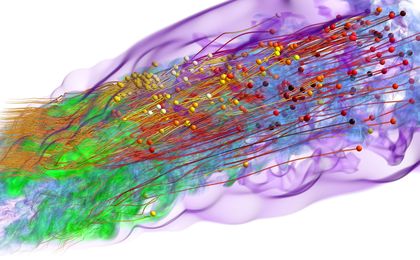
Supercomputers Model a New Type of Combustion

This article is an extension of our discussion about the complexities of combustion engines. National Geographic is following a story about a new supercomputer that the US is building. It’s called Titan and it will be ready for use later this year. Modeling a new type of combustion for engines was high on the list of things that would require the Titan’s processing power. Researchers are currently studying a new way of harnessing combustion for the use in automobiles. It’s called Homogeneous Charge Compression Ignition (HCCI) and it’s similar to diesel engines in that compression is used to ignite the air/fuel mixture instead of an electric spark. The key to HCCI improving efficiency is that it runs at much lower temperatures so that there is a lot less waste heat. However, HCCI is very sensitive to the chemical makeup of the fuel being used. That’s why the folks working on it need access to Titan in order to make a model that will allow them to study make a model of what goes on during HCCI.

HCCI requires complex fluid and chemical dynamics models

Head over to National Geographic to read up on the rest of the details.

Ford EcoBoost Tear Down

This is footage from the 2011 North American International Auto Show in Detroit. It’s the culmination of a promotion program that Ford did for the new at the time EcoBoost V6 that was going into their F-150’s. What they did was they pulled a standard EcoBoost engine off of the assembly line in their Cleveland Ohio engine plant. The engine was put on a dynamometer and put through a simulated 150,000 mile test which also included some thermal shock testing. The engine was then put into a F-150 where it was used to haul 55 tons of lumber up a mountain, tow 11,500 pounds for 24 hours straight around a track, performance hill tow testing and then its last stop was being put into a race truck that won its class in the Baja 1000. After that, the engine was taken back to Ford’s facilities in Dearborn with 164,000 total miles on it and it had only lost 1 of the 365 horsepower that it started out with. They then shipped it to the Detroit Auto Show and disassembled it for the first time in front of a live audience. The engine shows hardly any wear after the barrage of torture tests it was put through which is pretty impressive. It shows they had some talented engineers behind the engine design.

Ford is pretty ahead of the curve with this EcoBoost engine. It has a lot of the key technologies that we are going to see all car makers adopt in the near future to meet fuel mileage standards. Smaller displacement engines with turbochargers harness some of the heat energy produced by the engine to make more specific horsepower (power/liter). Direct fuel injection allows precise fuel control and better atomization in the combustion chambers. Variable valve timing changes how much the opening of the intake and exhaust valves overlap each other making sure it’s always optimized for engine speed. At higher engine speeds, the air coming into the combustion chamber is moving at a higher velocity and has more momentum. You want the intake valves to stay open longer because that momentum will keep carrying the air into the cylinder even while the piston is compressing it. The situation is different at low engine speeds when the air is moving slower. If the valves overlap too much at low speeds, the piston will actually push some of fresh air and fuel straight out of the exhaust before combustion happens. Having variable valve timing on both cams allow a computer to optimize the fuel usage and it also helps reduce turbo lag.

The video covers the entire demonstration and it runs about 50 minutes over three parts.

  Continue reading

The Creators of Tomorrow

Dr. Neil deGrasse Tyson was in North Carolina this past week to give a few lectures at the North Carolina Science Festival. He’s a very well spoken astrophysicist who is known for his promotion of science and engineering. Tyson shared that he knew that he wanted to be an astrophysicist at the age of 9 when he first saw the stars at the Hayden Planetarium in New York where he is now the director. When a little girl from the audience asked him what the best part about being an astrophysicist was, his replied, “Everyday I wake up I know there’s something about the universe that I don’t know yet.” During one of his lectures he also said, “The problem is most education tells you what to think rather than how to think it. Science is a method of inquiry. It’s the capacity to judge. That’s the scientifically literate mind.”

I’ve always found Dr. Tyson’s speeches inspirational for my personal engineering ventures. Some of my projects, including this blog and the electric RX-8, may seem like pipe dreams to some people, but I am not ashamed of that. Much of the work will be things that I will be doing for the first time. That means that I’m not guaranteed a 100% chance of success, but that’s point. Not following an already set path means there’s a sense of exploring and adventure. We live very safe lives in this modern age. Our survival and day to day living is pretty much guaranteed. That means our last frontier is here in science and engineering. I started this project not knowing how I was going to do it, just that I could and should. I hope listening to one of Dr. Tyson’s speeches will spark that sense of adventure in you as well.


This high resolution video of the space shuttle launch was just posted recently. This is what can happen when people are not afraid to dream and to create.