SRI EV1 Electric Off Road Racing – EV West

SR1 EV1 Baja Buggy via the EV West Facebook Page

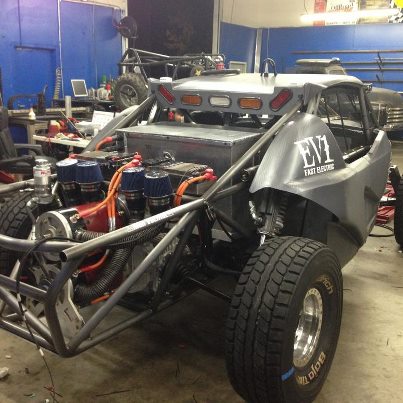
The awesome team of maniacs over at EV West continues to make innovations in practical electric vehicle performance. They like to use Netgain brushed DC motors with Evnetics controllers to produce motorsports-capable power for a fraction of the cost of equivalent high voltage AC systems. The Netgain motors are based on existing fork lift technology and have are proven performers in the EV community. The SRI EV1 uses two motors like their 700 horsepower E36 M3 Pikes Peak Car. The motors are stacked vertically at the rear of the buggy to work with the VW style transaxle. EV West chose to go with two 1000 amp Evnetics Soliton 1 controllers instead of one 3000 amp Soliton Shiva like in the M3. My guess is that using the two smaller controllers allows better torque modulation accelerating out of turns. They had to turn down the power from the Shiva in the M3 at Pikes Peak because it was breaking the tires loose too easily. The dual Soliton 1’s probably makes it easier to put down power on a two wheel drive vehicle on a loose surface. That doesn’t mean the SRI EV1 is a slouch. It makes 500 hp and 700 ft-lbs of torque with a range of 100 miles. Check out the testing footage:


Source: EV West on YouTube

Honda NSX-GT FR Hybrid

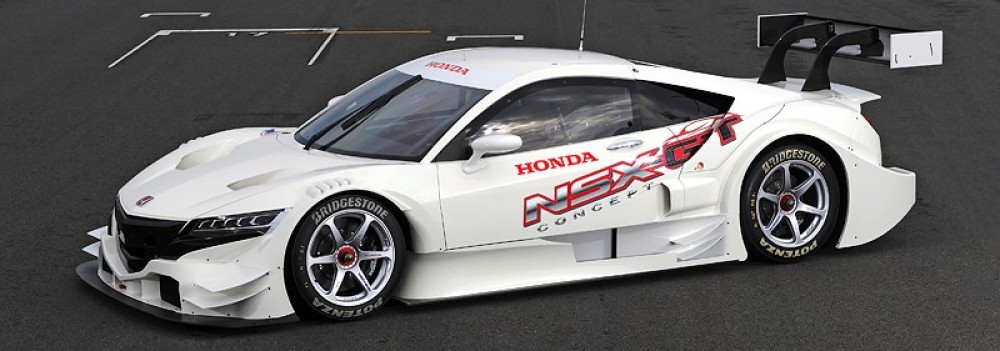
This is an interesting video for a couple of reasons. The first part has to do with the NSX-GT FR. The story behind the car begins in 2007 when the sanctioning body of the Japanese Grand Touring Car Championship (JGTC) announced a regulation change that would require all of the GT500 class cars to be front engine with rear wheel drive (FR) layout. At the time, Honda was racing with the mid-engine NSX. The NSX was Honda’s halo performance car with the rest of their sports car lineup being front wheel drive. The NSX-GT FR was built by Honda R&D to see how feasible it would be to adapt the NSX chassis to a FR layout. That’s why the nose of the car in the video will look abnormally stretched and it’s cornering attitude will seem a bit odd compared to the rest of the NSX’s you’ve seen. Honda ultimately decided to develop a clean sheet design for an FR chassis, the HSV-010, specifically for competing in JGTC. The NSX-GT FR was thought to have been scrapped, but it turns out it was just put into storage at the Honda R&D facility after it was used for testing in 2007.

The second reason this video is interesting is the re-emergence of the NSX-GT FR. Honda surprised the Japanese press when they randomly showed up at the Twin Rings of Motegi circuit with the car in 2010. It turns out they were testing a Kinetic Energy Recovery System (KERS) by Zytek, the same company that makes the KERS system currently used in Formula 1 racing. Honda R&D was seeing if KERS would be feasible for widespread adoption in the JGTC series. The NSX-GT FR was a natural candidate since it was already available and it wouldn’t give Honda any extra testing time with the HSV that was still being campaigned. If you listen carefully, you can hear the KERS working under braking and the car rolling down pit lane in pure electric mode.


Source: JDM Clips on YouTube

Nissan Leaf Motor

Nissan gives us a glimpse of their production plant in Decherd, Tennessee that makes the electric motor that powers the Nissan Leaf. The motors are currently all made in Japan, but production will be starting up in Tennessee about 70 miles from where the LEAF is assembled. Interesting fact of the day: The Nissan LEAF’s motor has more than 1 mile of copper wire wound inside of it.


Source: Nissan Newsroom on YouTube

2013 Tesla Model S – Translogic

Translogic’s Bradley Hasemeyer visit’s the Tesla factory to check out their first clean sheet designed car, the Model S. His interviews focus less on the details of the actual car and more on the innovative design philosophies that went into it. The interviewees talk about the reasons why Tesla chose to break certain conventions with the Model S.


Source: AOL Autos on YouTube