Sebastien Loeb Sets 2013 Pikes Peak Record in the Peugeot 208 T16

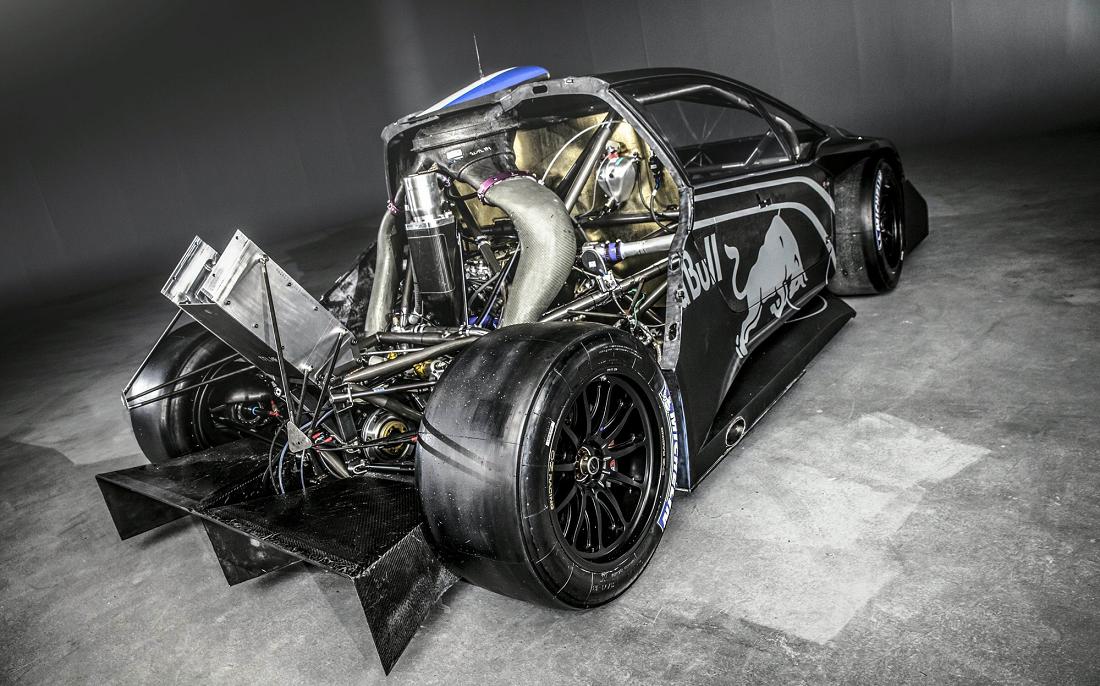
Peugeot-208-T16-069 time World Rally Champion and X-Games Rallycross gold medalist Sebastien Loeb made history last month by demolishing the record for the Pikes Peak International Hill Climb in Colorado. He piloted the purpose built Peugeot 208 T16 whose construction began in January of 2013. Luckily the engineers at Peugeot were able to raid the parts bin from their recently retired 908 diesel hybrid Le Mans race car. The front torsion spring suspension, engine air intake and rear wing are parts directly from the 908. The 3.2 liter, twin turbo, 60 degree V6 was also developed for competition at Le Mans in the Pescarolo-run C60. The engine makes 875 horsepower giving the 875 kg (1929 pounds) car an impressive power to weight ratio. Peugeot considered adapting the diesel hybrid drivetrain from the 908, but there simply wasn’t enough time to make it work. Time was also the main consideration for the decision to go with a tubular steel chassis instead of a modified unibody or carbon tub. Downforce produced by the 208 T16 is on par with a Le Mans prototype car which gives full utilization to the 2014 Le Mans spec Michelin tires and 18×13 wheels.

Loeb and Peugeot’s performance are really going to shake things up for Pikes Peak in years to come. To put things in perspective, Rhys Millen was able to beat his course record from last year by a full 44 seconds and was still 49 seconds behind Sebastien Loeb who posted an 8:13.878. Success breeds success so Peugeot may still unleash the technologies that they didn’t have time for this year. I’m sure they’d love to return to the glory of their back-to-back victories in 1988 and 1989 using what they had learned from the Group-B rally era. There’s some talk of them being the first to break into the 7-minute range next year. Until then, enjoy Red Bull’s on-board footage of this year’s run which was the first ever time posted in the 8-minute range:


Sources: June 2013 issue of Racecar Engineering, Autoblog and Red Bull on YouTube
2012 Combots Cup

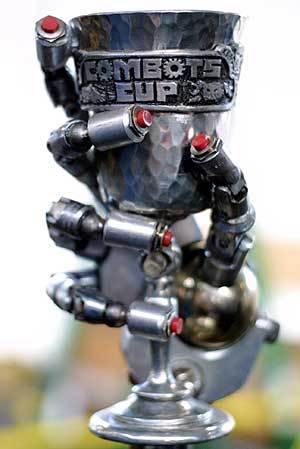
Combot Cup via San Mateo Event CenterPremiering in 2003, the Combots Cup is a continuation of the sport of robot combat started by the television show BattleBots which aired from 2000 to 2002. Even though the television show was deemed unprofitable, the idea of robot combat sparked the passion of the competitors which have been hosting the Combots Cup and Robo Games robot Olympics for the last 10 years. Interestingly enough, they still use the same style arena, rules and weight classes of the original BattleBots series. There are three popular types of combots: the basic wedge, pneumatic lifters and the high speed spinners. The winner of the tournament gets to take home the Combots Cup pictured to the left and put their name on it until next year’s event. The Tested channel on YouTube covered the 2012 Combots Cup and had a chance to interview the founder of the organization as well as some of the veteran robot builders. There’s also some fight footage:


Here’s some bonus high speed footage of the 2012 Combots Cup Champion, Last Rites. Wheelchair motors move it around the arena while an over-volted 25 horsepower golf cart motor spins its blade up to 2500 rpm producing a tip speed of 400 mph. The guys from the Distort channel set it loose on some used furniture and filmed the devastation in high speed.


Sources: Tested and Distort on YouTube

Insane Racing Best in Show Norway 2013

The boys over at Insane Racing just uploaded this video celebrating their win of the Best in Show award from the latest round of the 2013 Formula Offroad season at their home country of Norway. It seems like Best in Show involves just going for it all the time without being conservative about anything. Insane Racing likes to go for these trophies at all of the events. The resulting show is pretty incredible.


Source: Insane Racing on YouTube

Touge Monster Showdown

The Touge Showdown will always be one of my favorite bits of automotive media to watch. It’s a competition put on by the guys behind Best Motoring and Hot Version to see which Japanese tuners can build the best overall balanced car for street driving (touge is a term used for the mountain roads of Japan). The motivation was to discourage a troubling trend that the hosts noticed where tuning shops were selling customer hardcore extreme tuned cars with stiff suspension and stripped out amenities. While great for track racing, these cars were completely inappropriate for the average enthusiast driving on the street everyday. Cars participating in the Touge Showdown have to have full interiors, air conditioning and use street legal tires. A special twist and bumpy course was chosen to make sure the cars had enough suspension to be fast over imperfect tarmac.

This particular tournament is an all-star bash of previous tournament winners. Though filmed in 2011, this is the first time we’ve had access to them with English subtitles. There wasn’t enough demand for Best Motoring and Hot Version DVD’s in America to justify production, but the magic of digital distribution now makes it cost effective for us to be able to watch these videos. The free version is broken up into 4 parts with commercials every now and again to advertise the paid download version.

Part 1 has the guys testing out the two All-Wheel Drive entrants. First up is the C-Ser Subaru Impreza tuned by the guy who started Yashio Factory. The tuning focus of the Impreza was on torque which led to a 2.5 liter block, small twin turbos and a lower redline. The second AWD car is the MCR R35 GT-R. This is the first outing for the car with the HKS GT800R symmetrical double turbo kit.

Continue reading

Ford Freeform Fabrication Technology

The Ford Motor Company has come up with an interesting new variation on digital rapid prototyping. Usually when you talk about Computer Numeric Controlled (CNC) machines, they fall into one of two categories. The first is a subtractive process where a part is cut out of a block of raw material like a sculpture. The machine removes all of the waste material until all that’s left is the part as defined by the Computer-Aided Design (CAD) model. Additive CNC machines, like 3D printers, are a relatively new technology that have recently opened up rapid prototyping to enthusiasts everywhere. These machines build parts by starting with nothing and precisely adding material to the exact shape of the CAD model. What you’re left with is a physical representation of the digital information with no waste material.

Ford’s Freeform Fabrication Technology (F3T) is a new genre of rapid prototyping. Their machine takes existing raw material in the form of mass produced sheetmetal and manipulates it into the desired shape as defined by the CAD model. It appears that two round tip styluses press into the sheetmetal from the top and bottom in order to make the desired bends. After multiple passes, the two machines turn flat sheetmetal into the equivalent of a stamped part. The cool part is the finished product that comes out of the F3T machine should have pretty similar material properties and strength to the equivalent mass produced part without the time and money involved with making expensive dies. Like the other forms of rapid prototyping, this technology will be great for cost effective low production parts.


Source: fordvideo1 on YouTube via Gizmodo