Angus Mackenzie of Motor Trend is back with another truly excellent episode of Epic Drives. This time around he takes us to the garden of Europe, Sicily. While the active volcano and food culture there are unique attractions, it’s the roads that we’re interested in. The island of Sicily played host to the Targa Florio, a legendary historic race run along side the Mille Miglia and Le Mans. I’ll let Angus walk you through the history of the event, but it’s important to note that Porsche won the Targa Florio a record 11 times with lightweight mid-engine open top race cars. Their agility and durability allowed them to win over higher horsepower prototype cars. Mackenzie brings Porsche’s latest agile mid-engine roadster, the incredible all-new Boxster, to Sicily to drive the Targa Florio course once again.
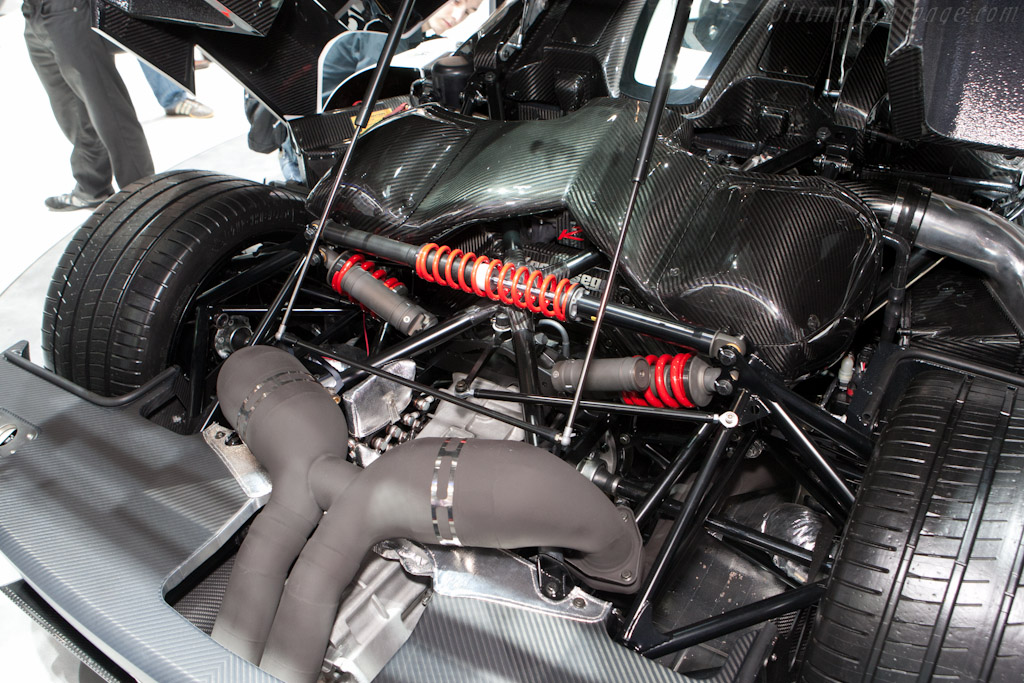
The Agera R is the latest contender in the top speed wars from Swedish car maker Koenigsegg. Armed with an E85 fueled twin turbo 5.0 liter V8, the Agera R makes 1150 horsepower and weighs only 3157 pounds. Since ethanol has about a third less energy density than gasoline, the engine’s fuel system flows enough volume to power a 2000 horsepower gasoline engine. Koenigsegg claims that the Agera R’s fuel system has the highest capacity of any car being produced. The rear suspension is a newly designed system called Triplex Suspension where a third spring and damper essentially acts as an anti-roll bar connecting the two sides of the suspension. Jethro Bovingdon seems to like the way the new system feels saying it doesn’t feel scary like the old CCX that famously went off course and ate a cone on the Top Gear test track.
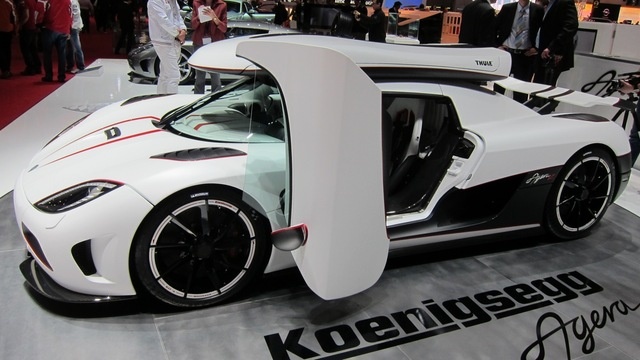
Other unique features include hollow spoke one-piece carbon fiber wheels and an active rear wing that is activated purely by air speed (there’s a good shot of it in the video). The car’s targa top is designed to be stowed in the front luggage compartment as a slight nod towards practicality. The first Agera R ever built also had a custom roof mounted cargo bin made in conjunction with Swedish bike rack maker Thule. The owner of the first Agera R chose a white color scheme in order to have the car look more like the Speed Racer Mach 5. There’s a shot of this car featured at the Geneva Auto Show at the top of the page.
Car and Driver’s European correspondent, Jethro Bovingdon, takes the Agera R for a spin around a race track next to the Koenigsegg factory before blasting it down Koenigsegg’s runway. The Agera R is theoretically capable of a top speed of 273 mph which would smash the Bugatti Veyron’s current record. We’ll have to wait for official record attempt to see if Koenigsegg can hold true to their claims.
If you’re a typical car guy, you probably don’t find driving hybrids very interesting. I don’t blame you. But just because the driving experience is usually sterile and unengaging shouldn’t undermine the fact that some serious engineering goes into making them work. This is a breakdown of the 2nd gen Prius transmission by an instructor at Weber State University where they work with Toyota on degree programs specifically having to do with the Hybrid Synergy Drive system.
The transmission is responsible for blending 3 different power input/outputs. The engine provides power to drive the car and to recharge the batteries, but it also requires power input to get started after it’s been turned off at stops. The two permanent magnet AC motors are referred to as Motor-Generators (MG1 and MG2) because they can easily be switched between propulsion and regeneration. MG1 is the smaller of the two electric motors and it acts as a starter, alternator and mainly as a generator fed by the engine power to recharge the battery pack. It’s also responsible for driving the car in reverse since that doesn’t require as much power. MG2 is the larger electric motor that is directly connected to the car’s wheels. It helps propel the car and is also responsible for regenerative braking. The engine and the two electric motors are tied together with a planetary gear set (ring gear, sun gear and planetary gear carrier). The video does an excellent job explaining how that works using the actual parts from the transmission.
The basic hybrid transmission architecture found in the Prius drive train was developed by a Japanese transmission company called Aisin and it is used by both Ford and Toyota. Does that mean that a Ford hybrid and a Toyota hybrid will get the same gas mileage since their hybrid systems have similar components and formats? Nope. Getting the best gas mileage is a complex puzzle of matching the power and torque requirements of the car with the efficiencies and operating points of the gas engine and electric motor. The gas engine is the most efficient at constant rpm and load like on highway driving. The electric motor provides better low end torque but it still has an optimum load and rpm. The planetary gear architecture basically allows an infinitely adjustable blend between the electric motor and the gas engine but you still need to know how to efficiently use it. When is the best time for the generator to use the engine power to recharge the battery pack? How low can the battery charge go before it needs to be recharged? Will using the electric motor’s low speed torque give the best overall gas mileage once the battery pack has been recharged? Should the gasoline be used to charge the battery or will more work be done if the same gas is burned to drive the wheels? It’s up to the software engineers to program the drive train controllers to figure out what the best combination of power input and output is for any situation the car sees. A good portion of the car’s price tag goes into the R&D and data crunching to figure these things out.
Check out Motor Trend’s latest episode of Head 2 Head. They take a look at the Toyota Prius V and the Ford C-Max hybrid. The guys do their usual excellent reviews of the cars, but the interesting part begins when the discussion turns to the gas mileage. Both cars didn’t get what the EPA rated them for and the Prius got the better real world mileage despite the C-Max having the better rating.
Even on a regular gas car, your mileage can vary massively based on where you drive the car (hilly terrain, higher elevations, traffic etc.) and how you drive it (pedal input smoothness, braking early, coasting etc.). The purpose of the EPA testing is not to tell you exactly what kind of mileage you will get, but to give you a standardized comparison between different cars. If you’re shopping for a hybrid, the emphasis really shouldn’t be on flat MPG figures as the Motor Trend guys have demonstrated. Your mileage will be based on how flexible your hybrid drive systems is. The car that will return the better gas mileage is the one that can consistently be the most efficient in a wide spectrum of driving conditions. It’s all in how the controls system (electric motor and gas engine blending) software is tuned.
The Motor Trend guys suspected that the Ford C-Max was tuned to rely on electric power up to a higher speed specifically to do better on the EPA test which ironically made it perform worse in real conditions. This result enforces story a few years ago about Prius drivers who would try to drive slower in an effort to keep the transmission from turning on the gas engine. This technique ended up giving the drivers worse gas mileage because it was completely depleting the battery pack. The system would then have to turn on the gas engine and run it at full recharge through the generator which reduced the overall mileage. The moral of the story is to do your research. What you want to look for is gas mileage consistency. What are other owners getting? Are people in different situations getting similar mileage or do the results vary a lot? My advice would be to put less emphasis on the EPA numbers and high score mileage numbers and try to find the hybrid that returns the least deviation in mileage numbers among a large number of owners. What you need to find is which automaker’s engineers did the best job programming the hybrid system to react to real world driving conditions. It’s a whole new ballgame for evaluating how well cars work. Now you have to look at how well the car is bolted together as well as how refined and effective its software package is.
Automobile Magazine has just announced the Tesla Model S as their 2013 Automobile of the Year. This is big news for the electric vehicle world because the Model S has won out in direct comparison to equivalent gasoline cars. The car is praised for universally recognized strengths and not for being the best of a standard that was lowered for EV’s. Tesla has finally given the world an electric car that is designed and executed well enough for regular customers to consider purchasing it as a daily use car and not because it’s a novelty item. An EV that’s better than a gas car? It can be done.
Automobile’s full written article about the Tesla S can be found here. I also found this bonus footage of the impromptu drag race between the Model S and the BMW M5:
Chevrolet is commemorating the end of the C6 with this special edition 427 Corvette. Carlos Lago of Motor Trend takes it for a spin while reminiscing about the C6 Corvette’s quirks as well as the attributes that made it an unrivaled performance per dollar bargain.