This is the final lap of the 2010 Gold Coast round of the Australian V8 Supercar series. Series champion, Jamie Whincup, has to hold off a hard charging Shane Van Gisbergen to win the race. They make some contact, but it’s still classy racing. This is why I like this series so much.
This is another video from astronaut and chemist, Dr. Don Pettit, on the International Space Station. He’s the same guy who made the Bubbles and Anti-Bubbles in Space video. This time he’s experimenting with water droplets on speakers. He’s playing tones through the speakers and sweeping through different frequencies to observe their effects on the droplets. The interesting thing about this is that there is no gravity to dissipate the waves from the surface of the water. The water droplets are able to hold some very interesting shapes depending on their size and the tone frequency.
To break this down even further, you have to take a look at wave behavior. Lets take what we’re seeing on the surface of those water droplets and break it down into a 2D scenario. This is a crash course on standing wave behavior by Professor Brian Cox with help from Simon Pegg. Before you watch it, remember that the surface of water has elastic properties due to surface tension. That’s to say that you can put energy into it by stretching it and it will use that energy to return to its original shape.
Now to bring it all together, the spring in the second video is the equivalent of the surface of the water droplets in the first video. How big the water droplet it effectively changes the spring rate, or how stiff the spring is. The two guys moving the ends of the spring in the second video are the equivalent of the speaker making tones in the first video. If you expand the spring into a three dimensional dome shape, you can start to see why the water droplets look the way they do in the first video. When the spring is excited slowly, you get a small number of very large waves (2D) or ripples (3D) that move slowly. As the frequency increases, the excitation is moving faster and you get a lot more small waves and ripples that are moving at much higher speed. As the frequency gets very high, the surface of the droplets become chaotic and that’s when it starts to shoot the droplets off. Knowing what you now know about wave behavior, what do you think the answer to Don’s Challenge Question is?
Car Nifty TV just posted this video of some of the competition battles of the rainy Odaiba round of the D1GP Drift Championship that took place last month. Some highlights include Manabu Orido’s IS-F powered FT-86 (Scion FR-S/Subaru BRZ) going head to head with Hibino’s Subaru EJ25 powered FT-86. There’s also the owner of Vertex Aero’s 2JZ powered BMW 3-Series going up against Nobuteru Tanaguchi’s Altezza (Lexus IS300). The round was won by Daigo Saito in his JZX100 chaser.
Russel Sutton is a man from Australia who decided to build his own 9 cylinder radial engine to put on his airboat. It uses a custom machined block and rod system with Holden Commodore V6 pistons and cylinders from Honda XR600 motorcycles. Check out Part 1 on his project for all of the build details. Sutton got the engine to the point where it was ready to start up and he captured it on video for the rest of us to enjoy. Unfortunately, having the engine run exposed some of its weaknesses that will have to be addressed before it will be blowing Russel’s hair back on his airboat. Watch the videos and read the article over on The Kneeslider for all of the details.
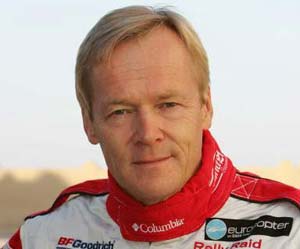
Climb Dance is an award winning short film that was produced in 1989. It follows Finnish World Rally Champion, Ari Vatanen, as he climbs Pikes Peak in a Peugot 405 T16. Vatanen won the World Rally Championship in 1981 with Ford before signing with Peugeot in 1984. He piloted the Peugeot 205 T16 during the crazy Group B era. Ari was well known for never playing it safe. He would always push hard and go for the win even when he had a lot to lose. My favorite quote of his came during an interview about the Group B rally years. He said “I always listened to my heart more than my brain. Yes, you will miss out on many victories but you will never have a boring life. Not a dull life.” In Climb Dance, Ari is piloting Peugeot’s last Group B car, the 405 T16. The car is four wheel drive and four wheel steer with over 600 horsepower. He says on his website that instead of shifting down to lower gears, he keep the car in higher gear and slipped the clutch. The reason for this technique was that the power delivery was so vicious in the 405 that it would cause a lot of wheel spin on the gravel surface which caused him to lose time.
**EDIT** May 16th, 2013: This video was remastered in HD
Knowing that the driver and the car are veterans of the almost mythical unlimited performance era of Group B rally adds a special feel to the vintage video. It’s a tribute to an age in rally that we will never see again. The cars were so fast that they were dangerous, yet the legendary drivers of the day rose to the challenge of piloting them to victory. To me, being able to see a piece of that time is just as, if not more, exciting than watching Monster Tajima’s current record run up Pikes Peak.