Scion Racing uploaded this behind the scenes build of Ken Gushi’s FR-S drift car for this year’s Formula D Drifting Championship. Aftermarket parts manufacturer Greddy handled the construction of the car. The video had a few interesting details that I was still curious about. They advertise the engine as a flat-4 that produces 500hp. I didn’t think it would be possible for them to have already developed the stock 2.0 liter with a brand new direct injection system to that level. There’s a scene in the video where they clearly show a Cosworth engine going into the car. That means it’s more than likely a Subaru EJ25 based engine much like Hibino’s D1 car in Japan. I’m excited to see how well Ken Gushi and Scion Racing does this year after having to campaign a special exception rear wheel drive converted tC for the last four years.
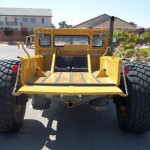
I came across this project on Ebay Motors a couple of weeks ago and it was too awesome not to share. It’s a hot rod based on a full sized industrial truck. From what I can tell, it’s powered by … Continue reading →
The W Racing Team (WRT) has been releasing these documentaries of their race weekends as they campaign two Audi R8 LMS cars in the Blancpain Endurance Racing Series in Europe. The cars use the same V10 as found on the Lamborghini Gallardo, but are RWD only. I really enjoyed these videos because they give an inside look into how much preparation the entire team does for every event. They’ve posted videos for the first two rounds so far. It looks like they were chasing some suspension setup issues in the first round and had some tire choice difficulties in the weather for the second.
Motor Trend has been doing this series on YouTube that pits two cars “Head 2 Head.” This episode is particularly interesting for more reasons than just the Mustang vs. Camaro rivalry. It’s old school analog vs. new school digital. The new Camaro ZL1 is GM’s first entry into the world of the electronic sports car that was ushered in by the Nissan GT-R in 2008. It’s been equipped with a sophisticated traction control system and magnetorheological shocks. Traditional shocks use valves that restrict oil flow through its body to control motion. The magnetorheological shocks use electromagnets to control the flow of magnetic fluid through their bodies. This allows a computer to read the road surface with a sensor and then adjust the damping forces of the shock with the electromagnets. The same type of system is used on the Cadillac CTS-V, Corvette ZR-1 and the Ferrari 458 Italia, but the ZL1’s shocks are the latest generation of the technology.
What this showdown boils down to is the digital vs. analog driving experience. The computers in the ZL1 aid the driver in maximizing the potential of the car when putting down lap times. However, it still doesn’t drive the car for you. A driver with skills will still put down faster times than a novice in the ZL1. That’s where cars like the Mustang Boss 302 Laguna Seca come on. The Mustang can be driven without driver aids. What the car does is in direct response to the driver’s input. The analog car gives you plenty of feedback so you can push to the absolute limits. Get it wrong and it will punish you, but that’s how you learn to become a better driver. The digital age of the sports car is great, but I hope that it grows hand in hand with the traditional analog car instead of completely taking it over. I think both are necessary so that drivers can grow along with technology of the cars. The technology has to amplify driver skill, not replace it.
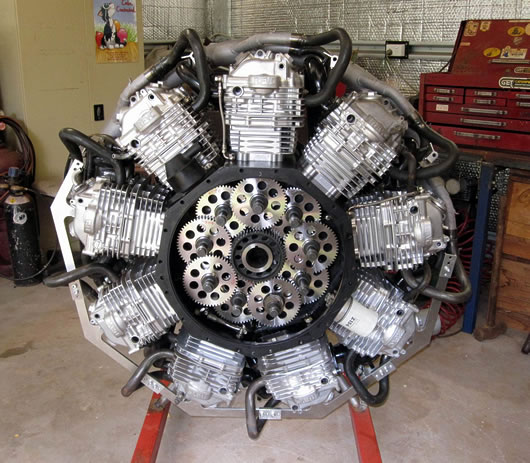
The Kneeslider motorcycle blog has been featuring this radial engine project by Russel Sutton of Australia. He has always loved radial engines and he needed something for his airboat, so he decided to build one using V6 Holden Commodore pistons and cylinders from Honda XR600’s. The engine has 8 liters of displacement and will redline at 4000rpm. The cylinders of air cooled engines are removable since they don’t have coolant passages that link them with the rest of the engine. Sutton machined the crank, rods and crank case with oiling system himself. Head over to The Kneeslider, Part 2, Part 3, Part 4 and Part 5 for more pictures and specs. Part 4 has YouTube videos of Russel explaining and testing the oiling system.